Is a Penguin a Bird? Clearing Up the Confusion
Penguins are fascinating creatures that have captured the attention of people around the world. However, there often needs to be more clarity about whether penguins are birds.
The answer is yes; penguins are indeed birds. Despite their flightless nature, penguins are classified as birds due to their shared characteristics with other aves.
Penguins belong to the family Spheniscidae, encompassing 18-21 species of flightless marine birds. They are predominantly found in the Southern Hemisphere, except the Galápagos penguin, which resides north of the Equator.
Penguins can be found in various habitats, including ice-covered regions, rocky coastlines, and sandy beaches. They have adapted to their environments uniquely, such as their specialized feathers that keep them warm in cold waters.
Is a Penguin a Bird?
Penguins are a unique and fascinating species that have captured the attention of many. One question that often arises is whether penguins are birds or not. The answer is yes; penguins are classified as birds (Aves) under the zoological classification system.
Explanation of the Bird Classification
To understand why penguins are classified as birds, it’s essential to understand the characteristics that define birds. Birds are warm-blooded, feathered, egg-laying vertebrates with a four-chambered heart and a lightweight but strong skeleton. They also have wings, although not all birds are capable of flight.
What Makes a Penguin a Bird?
Penguins share all of these characteristics with other birds. They have a four-chambered heart, lay eggs, and have feathers and wings. However, penguins are flightless, one of the features that sets them apart from other birds.
Beak Structure and Function
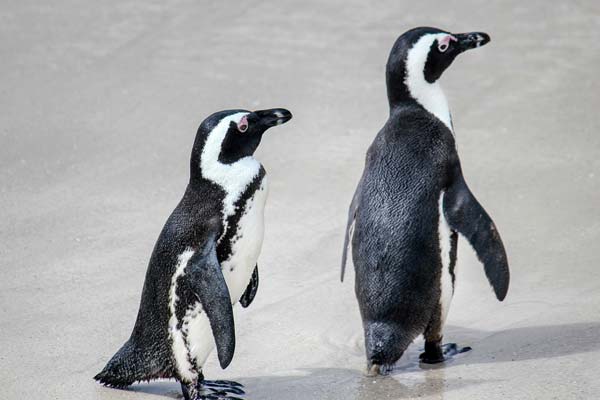
Penguins have a beak that is specially adapted for catching and eating fish. The beak is narrow and pointed, allowing them to pierce through the fish scales and grasp them firmly.
Egg-Laying Characteristics
Like other birds, penguins lay eggs. However, penguins lay their eggs on land rather than in the water. This is because penguins adapt to living in cold, harsh environments, and keeping the eggs warm and protected on land is easier.
Presence of Feathers
Feathers are another characteristic that defines birds, and penguins have them too. Penguins have a layer of feathers that helps to keep them warm in cold water. They also have a layer of down feathers that provides additional insulation.
Skeletal Features Unique to Birds
Penguins have lightweight but strong skeletons, another characteristic that defines birds. Their hollow bones are air-filled, making them lighter and more buoyant in water.
Adaptations in Wings for Swimming
Although penguins are flightless, their wings are adapted for swimming. Penguin wings are flattened and stiff, which allows them to “fly” through the water. They use their wings to steer and propel themselves through the water, much like a bird uses its wings to fly through the air.
Fun Facts About Penguins
Penguins are fascinating creatures that have captured the hearts of many people worldwide. Here are some interesting and lesser-known facts about penguins that will make you appreciate them even more:
Penguins are birds, but they are flightless. They have evolved into excellent swimmers and divers, with streamlined bodies, flipper-like wings, and webbed feet that help them navigate underwater.
Penguins comprise 18 species, exclusively inhabiting the southern hemisphere, ranging from Antarctica to the Galápagos Islands. The emperor penguin holds the title for the largest species, standing at 4 feet tall and weighing up to 90 pounds, while the little penguin claims the smallest, measuring around 16 inches in height and weighing approximately 2 pounds.
Penguins mate for life and are monogamous, which means they stay with the same partner for multiple breeding seasons. They typically lay one or two eggs, which both parents take turns incubating and caring for until the chicks are old enough to fledge.
Penguins have a unique way of keeping warm in their cold aquatic habitat. They have a layer of insulating feathers, a thick layer of fat that helps them retain heat and a counter-shading coloration that makes them less visible to predators above and below the water’s surface.
Penguins have specialized beaks adapted to their fish, crustaceans, and squid diet. Some species, like the gentoo penguin, have longer beaks that allow them to catch larger prey, while others, like the chinstrap penguin, have shorter beaks better suited for smaller prey.
Penguins are highly social creatures, residing in varying-sized colonies, from a few dozen to thousands of individuals. They communicate through diverse vocalizations and body language, frequently huddling together for warmth and protection against the elements.
Penguins confront multiple challenges to their survival, including habitat loss, overfishing, pollution, and climate change. Some species, like the African and erect-crested penguin, are considered endangered or critically endangered. Conservation initiatives are actively working towards safeguarding these remarkable birds.
FAQs
Is a Penguin a Bird or a Mammal?
Yes, Penguins are birds, not mammals. They are classified as birds because they have feathers, lay eggs, and have beaks. Although they are flightless, they are still considered birds because they have wings, which they use to swim through the water.
Why is a Penguin Classified as a Bird?
Penguins are classified as birds because they have all the characteristics of birds. They have feathers, lay eggs, and have beaks. They also have wings, which they use to swim through the water. Although they are flightless, they are still considered birds because they have wings.
Is a Penguin a Bird?
Yes, penguins are birds. They belong to the Spheniscidae family, which consists of flightless birds inhabiting the southern hemisphere. Penguins exhibit all the characteristic traits commonly associated with birds.
Can Penguins Fly?
No, penguins cannot fly. Their wings have evolved for swimming, functioning as solid flippers in the water. Penguins lack flight feathers, unlike other birds, and their wings cannot be folded. Consequently, they are specialized for underwater propulsion rather than aerial locomotion.
What Species is a Penguin?
There are 18-21 species of penguins, all of which are flightless. Most penguins live not in Antarctica but somewhat between 45° and 60° S latitudes, where they breed on islands. A few penguins inhabit temperate regions, and one, the Galapagos penguin (Spheniscus mendiculus), lives at the Equator.
Conclusion
In conclusion, penguins are indeed birds, despite their inability to fly. They belong to the class Aves and share many characteristics with other bird species, such as laying eggs, having feathers, and being warm-blooded. However, they have adapted to their unique aquatic lifestyle, with their wings evolving into flippers for swimming.
Penguins are a fascinating species group, with 18-21 different types found exclusively in the Southern Hemisphere. They are well-known for their distinctive black-and-white coloring and ability to survive in some of the harshest environments on Earth.
While penguins share many similarities with other bird species, they also have some unique features that set them apart. For example, they lack flight feathers and have solid flippers instead of wings.
Additionally, they have a specialized gland that helps them remove excess salt from their bodies, which is necessary for survival in saltwater environments.